The story below is from our November/December 2022 issue. For more stories like it, Subscribe Today. Thank you!
Roanoke was once home to the largest Sears store in the American South.
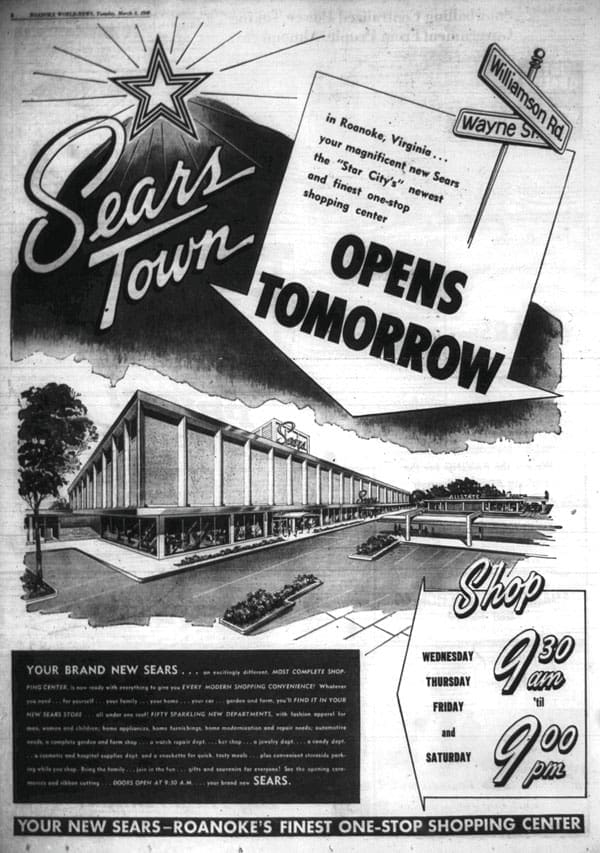
It was the largest retailer in Roanoke when it opened on March 6, 1957. Sears Town on Williamson Road was a 100,000-square-foot shopping Mecca, and the largest Sears store in the American South.
“From diamonds to tropical fish. From shrubbery to cuckoo clocks. You name it Sears has it. And in a beautiful new building of brick and glass occupying a city block on Williamson Road,” reported the Roanoke Times. “Yes, there’s a Sears answer to your family’s every need. In addition, you may buy All-State Insurance right in the store; grab a quick lunch at the store’s short-order counter; or make use of the complete super-service station Sears offers its customers.”
Full page advertisements in both of Roanoke’s dailies declared “5 great stores in one.” Sears Town had an apparel department with Sears’ brand names — Kerrybrooke, Fashion Tailored, Pilgrim, Boyville and Honeylane — for men, women and children. The furniture store contained floor coverings, curtains, linens and housewares, all with the Sears’ Harmony House label. The appliance department stocked Coldspot refrigerators, Kenmore washers and dryers, and Homart dishwashers. In hardware, Craftsman tools, paints and building materials surrounded the Homart Kitchen Center. The service station could meet every need for autos and motorcycles. It truly was a one-stop shopping center.
Sears Town’s catalog department promised customers that any items ordered from their catalogue — from a roller skate key to a $3,650 cabin cruiser — would be shipped to Roanoke by the next day from their warehouse in Greensboro. A special telephone unit was set up in Sears Town for those that wished to shop from home using the 1957 Sears Roebuck catalogue that was 1,400 pages and weighed five pounds. If one did not receive it in the mail, the company had placed multiple copies conveniently in the city’s libraries.
At the helm of Roanoke’s Sears Town was George Sellers, a native of Florida, who had quickly worked his way up through the company’s “promote from within” policy. He had joined Sears in 1944 beginning with their New Orleans store and after several moves became the manager of the Sears store at Tallahassee, Florida. In 1956, Sears moved Sellers to Roanoke for the purpose of launching Sears Town.
Roanoke’s Sears Town was meticulously designed with every detail calibrated to enhance the shopping experience. The store used over one hundred color schemes from the Sears Harmony House Plan, all available in the paint department. Sears had conducted extensive marketing research to determine the hues to which customers would respond favorably.
Shoppers were treated to a variety of background music — classic, semi-classic and popular. The music played was “scientifically selected” according to company officials to coordinate with the time of day and what Sears believed were the corresponding moods of shoppers. Sellers stated, “The system is not designed as entertainment but to increase the shopping and working pleasure of our customers and employees.”
The large windows were the most noticeable architectural feature of Sears Town, and like all other aspects of the retail center were trend-setting in their use. Rather than the typical display windows used by retailers to showcase seasonal items, Sears Town devised what they called “visual front windows” that put the entire store on display for passing motorists and pedestrians. Nothing inside interfered with the view of seeing the entire range of merchandise, and that meant having items displayed on lower shelves near the front with shelves rising taller toward the rear.
What set Sears Town apart, locally and nationally, was the company’s corporate decision to leave America’s downtowns and establish mall-like retail centers where shoppers could find almost everything. Sears’ executives had foreseen the seismic shift in shopping patterns with the impact of the automobile.
Considered revolutionary at the time, Sears began to design their stores with the “driving shopper” in mind. For Roanoke’s Sears Town that meant an adjacent service station and an expansive parking lot that could accommodate 650 cars. Sears, which had been on Church Avenue in downtown Roanoke since 1929, closed that location four days prior to the opening of their new mega-store.
On opening day, a Wednesday, an estimated five thousand shoppers poured through the main entrance when the store unlocked its doors at 9:30 a.m. Roanoke Vice-Mayor W. B. Carter and Sellers held a ribbon-cutting ceremony using garden shears. The first recorded purchase, a garden hose, was made by Mrs. J. R. Toms of Roanoke. The previous night, Roanoke’s business and civic leaders had been given a tour followed by a dinner at Hotel Roanoke. Sears’ vice president, Charles Kellstadt, addressed the gathering boasting, “Sears does business with one of every three families in the nation.”
With over 500 employees, Sears Town was cutting edge for Roanoke’s retail scene and a harbinger of the decline in downtown Roanoke as a retail center in the late ‘50s and early ‘60s. When a Kroger opened adjacent to the mega-store, most shoppers really could find everything at the one-stop, park-for-free, block-long Sears Town. Even Santa Claus made more grandiose entrances there, arriving each Christmas by helicopter.
A few years after its opening, Sears Town was followed by Towers Shopping Center, Roanoke-Salem Plaza and Crossroads Mall. Each contributed to the demise of downtown’s retail. But in the summer of ’57, all headed to Sears Town where it was “satisfaction guaranteed or your money back.”
The story below is from our November/December 2022 issue. For more stories like it, Subscribe Today. Thank you!