The story below is from our May/June 2020 issue. For more stories like it, Subscribe Today. Thank you!
The Roanoke Valley had two prisoner of war camps during World War II.

On the night of of October 25, 1944, the switchboard at the Roanoke Times was flooded with calls seeking information as residents feared a Nazi invasion of Virginia was underway.
The callers were responding to a radio alert that had been issued that afternoon for members of the local Virginia Reserve to immediately report for duty at the Roanoke armory due to an undisclosed “emergency.”
The emergency was the search for an escaped German prisoner of war who had slipped away while working in an orchard near Troutville.
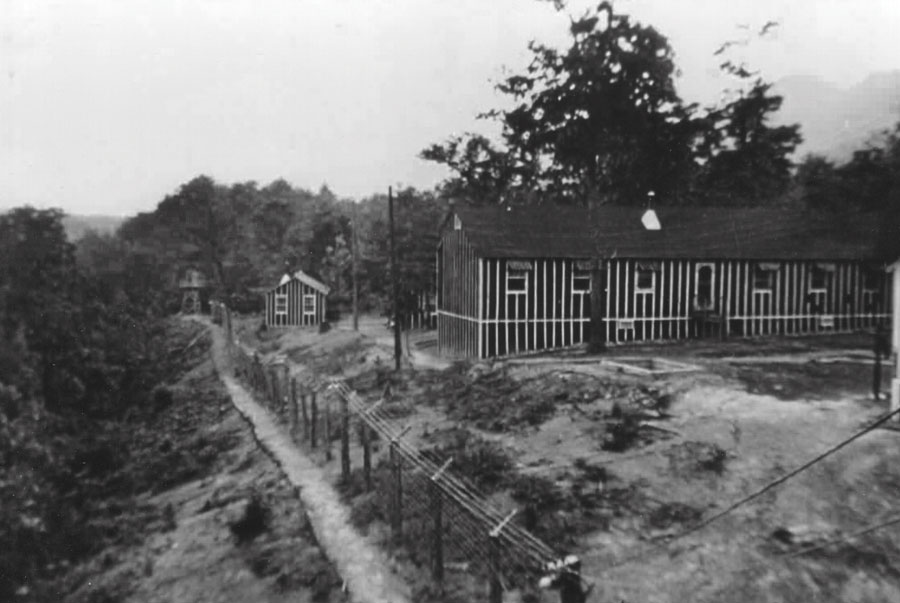
During World War II, the Roanoke Valley had two German prisoner of war camps, one at Catawba and the other at Salem. Some two hundred German soldiers were temporarily relocated to the area having come from Camp Pickett. The first prisoners arrived in 1944 primarily at the request of the Roanoke County extension agent, J.B. Williamson. Williamson had been lobbied by valley orchardists of the need for laborers given most local young men were in the military.
In addition to harvesting apples, the German prisoners also worked for the Roanoke water department clearing the land that would become the basin for the Carvins Cove reservoir. According to water department documents at that time, the prisoners worked eight-hour days for fifty cents per hour. There was to be one guard for every ten prisoners.
While army regulations clearly stated there was to be no conversation between the prisoners and civilians, this was not strictly observed. Gordon Saul recalled interacting with the prisoners as a water boy at the Watts Farm during a wheat harvest.
“Me and two ten-year-old buddies…worked for several days carrying water to the thirsty workers. Being naturally curious boys we wanted to know how the fighting was going in Germany and if these prisoners had shot any Americans. The Germans would always laugh good-heartedly and say, ‘Oh no! We shot only Ruskies!’”
At the Crumpacker Orchards in Botetourt County, the prisoners were occasionally offered a home-cooked meal, allowed to eat at the family’s dining room table. Even years after the war, some prisoners corresponded with the families on whose farms they had worked.
By all reports, the German soldiers were quite pleasant and in some ways glad to be out of combat zones in North Africa and working orchards, raising barns, and clearing timber in the Roanoke Valley. A few returned to the Roanoke Valley in the decades that followed to revisit the camp sites and work locations.
Werner Krauss was 19 when he came to the POW camp at Catawba. In 2000, he made a trip back to the camp. By that time, the property had been acquired by the Roanoke Valley Baptist Association and converted into Ward Haven Retreat Center, as it is today.
Krauss recalled the farmers coming with their pick-ups and requesting two or three laborers for the day. After the war, Krauss eventually returned to Germany, but finding it in ruins tried to become an American citizen. With his application denied, Krauss went to Canada.
During his 2000 visit, he said, “It’s kind of ironic that you wanted to go live in a country where you were a POW because you were treated so well. I think it’s a wonderful compliment to the American people.”
While writing my recent book The Roanoke Valley in the 1940s, I became well-acquainted with the POW camps and the various work the prisoners did in the valley, making certain to include all such details in the book. What I lacked were photographs of the camps, as none existed with any local museums or libraries.
Literally days before my publisher’s deadline, a man visited the Salem Museum whose father had served as a guard at the POW camp in Catawba and shared photos his father had taken while stationed there. They are in the book and a few accompany this article, thanks to the museum’s Library Committee alerting me to their existence.
As for the emergency of late October 1944, the escaped prisoner was Hermann Neumann. On the lam for two days and with little command of English, Neumann was spotted along a highway near Coyner Springs.
Roanoke police, the local Virginia Reserves unit, and camp guards searched in vain for the 21-year-old. Finally on October 29th, Neumann, hungry and tired, walked up to the front door of Sam Smelser’s farmhouse and surrendered. With his arms held high, Neumann identified himself to the farmer and said he was ready to go back to Catawba.
There were a few other escape attempts by others, none successful. The German soldiers remained in the Roanoke Valley until April 1946, when what few were left at Salem were transferred back to Camp Pickett. The two camps were sold a year or two later by the War Assets Administration.
To read more from our May/June 2020 issue, Subscribe Today. Thank you for supporting local journalism!