In the midst of the hard times of the Great Depression, wages fell, banks closed, car sales plummeted.
About a quarter of the way into what would turn out to be nearly four years of depression, the Roanoke area was well into the throes of hard times in 1931.
At the beginning of the year, the Bank of Vinton was found solvent and allowed by the State Corporation Commission to re-open, having been closed down, along with a record number of banks, during 1930.
Other economic news over the year would not be as positive, despite a collective characterization of the situation as a recession, with recovery expected soon.
A few examples:
• N&W revenue was “down sharply” (owing to the economic conditions as well as competition from gas-powered vehicles), and the Virginia Railroad saw a decline in income of more than $1 million.
• According to Roanoke historian Raymond Barnes: “Hundreds of auto salesmen, real estate agents, registered nurses, commission salesmen, etc technically had jobs, but no ‘employment.’” He notes too that many without jobs spent their time gathering chestnuts from trees succumbing to the blight.
• All city employees saw their salaries cut by 10 percent, saving the city about $35,000.
• Nationally, automobile production was down about 35 percent.
And while there are many similarities between those hard times and these, it turns out the old saw about an increase in movie attendance – people staying near home and indulging in fantasies rather than traveling and coming closer to living them out – is not true after all.
While attendance jumped by about 12 percent during the first quarter of ‘09 vs ‘08 (and went up by a similar measure in the 1982 recession), such was not the case in the Depression. Perhaps part of the reason is that just before the Depression, about 65 percent of people reported having attended a movie in the previous week, versus about 10 percent today; perhaps there was no way to go but down.
The economic news was not all bad. In the teeth of the gathering hard times, at least two business names that would be a part of the Roanoke Valley for many years to come saw their beginnings in 1931: Arthur Taubman was preparing to leave his Baltimore operations an move to Roanoke to open the first two Advance Auto stores. And Nathan Fink had just begun operations at the first of the Fink’s jewelry stores in the valley.
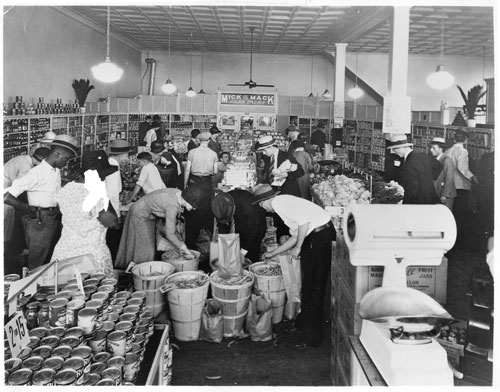
Mick-or-Mack 1931 vs. 2009: On The Grow vs. Nearly Gone
Despite the drop in food prices in 1931 – steak fell to as low as 25 cents a pound and grapefruit to four for 15 cents – Roanoke-headquartered Mick-or-Mack opened a new grocery at the corner of 11th and Patterson.
The store was the 43rd (in 38 Virginia towns) and there were plans for seven more to open soon.
Roanoke’s hometown grocery chain, which had opened its first store in 1927 at First and Church, reached its high point in the 1940s, with about 60 stores, before the A&Ps and Krogers of the world began to make serious inroads into the grocery trade as a local enterprise.
The local chain was also hurt, over the ensuing decades, by clinging to practices such as daylight hours, Sunday closings and S&H Green Stamps as its marketing key.
By the mid-’80s, Mick-or-Mack was down to 13 stores, with local ownership – begun with the McVeigh family – long since a things of the past.
Look for Mick-or-Mack in the phone book today and you find “Mick-or-Mack Galaxy Food Center” on Winborne Avenue just off of Memorial in the Grandin Village area. The small store, with its big green Mick-or-Mack signage intact, is part of the 110-store Galaxy group, in seven states. Market share for the big green sign, at 29 percent as recently as 1978, is too miniscule to measure in a market dominated by Kroger.