The story below is a preview from our May/June 2016 issue. For the full story Subscribe today, view our FREE interactive digital edition or download our FREE iOS app!
Location
West of downtown between Campbell Avenue on the south, Salem Avenue on the north and 18th Street on the west.
Significance
As part of West End, Roanoke’s earliest suburb, Patterson Avenue was home to some of Roanoke’s wealthiest families and most breathtaking Victorian mansions. The area is now listed on the National Register of Historic Places and Virginia Landmarks Register.
History
Hot shot developer Ferdinand Rorer came to Roanoke, née Big Lick, in 1850 and bought a large expanse of farmland west of the city. After the Shenandoah Valley and Norfolk & Western railroads merged in 1882, Rorer advertised 2,500 lots for sale as home building sites in what is now known as the West End and includes Hurt Park and Mountain View neighborhoods. Rorer laid out the street grid that is still used today. Having a penchant for putting his name on things (Rorer Hall, Rorer Park Hotel), he used family names for several of the streets in his new development (Ferdinand, Chapman, Rorer, and Patterson).
In 1888 a group of city bankers and industrialists organized one of Roanoke’s largest real estate firms and bought 15 blocks of Rorer’s development and started marketing it through the West End Land Company.
The company advertised its development as an “elite suburb” and zoned it exclusively for “good handsome dwellings.” Lots sold briskly and by 1890 several tasteful and expensive Italianesque and Queen Anne mansions had gone up. When first developed, West End was home to the people who owned the railroads as well as those who worked there.
Features
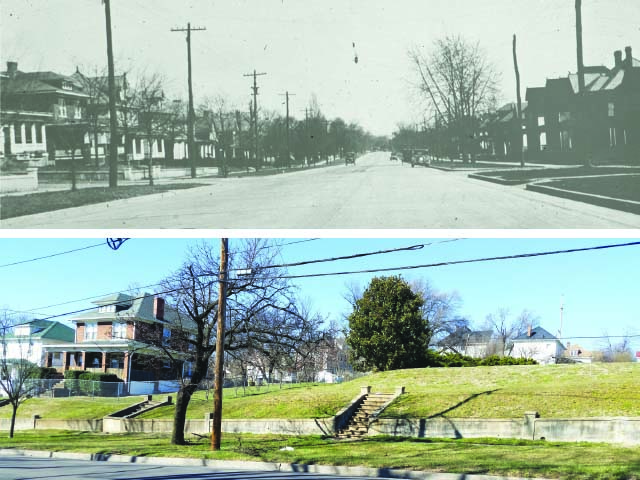
Handsome Victorian mansions lined the north and higher side of the wide street nicknamed The Boulevard and looked down on attractive, though less imposing, neighbors across the street. West of 13th Street, Patterson widens to 100 feet with 20-foot wide planting strips. The street car ran from 1892 to 1945. Most of the mansions had wide concrete steps leading from the street to the walkway up to the house. Today many of those steps lead to empty lots, a sad reminder of the grandeur that once was.
What Happened?
Times changed, tastes changed, and the next great ‘burbs beckoned. Patterson Avenue’s heyday seems to have been remarkably short, approximately 1890 to 1920. By the mid-‘20s, families were becoming smaller, servants were less plentiful, the automobile had arrived, and the latest, greatest new suburbs—South Roanoke, Virginia Heights, Raleigh Court, and Wasena—were luring residents with promises of pure air, water, sewer lines, electricity, paved streets and sidewalks.
The West End also suffered from the city’s lack of zoning sense at the time. Along with fabulous mansions, West End from the beginning was also home to railroad operations, as well as a bunch of railroad-related industries, including Crozier Steel and Iron, West End Furnace, and Rorer Iron Works. Rich folks no longer wanted to live cheek-by-jowl with heavy industry, no matter how grand the house or wide the boulevard, or how convenient it was to work.
It was time for wealthy white families to pack up and move to greener lawns in the suburbs, leaving the grand old Patterson Avenue mansions to suffer a fate common to urban neighborhoods across America. As the affluent moved out, moderate and lower-income residents took their place.
For 50 years the exodus and downhill slide continued, until the 1970s when new residents awoke to the splendors of house quality and craftsmanship and the city awoke to the need to preserve the treasures in its old neighborhoods.
Prognosis
Patterson will never look like it did in the early 1900s, but with the effective partnering of the city, active and engaged neighborhood organizations, the West End Center for children, residents and landlords, and businesses such as Freedom First Credit Union, the future of Patterson Avenue, in fact the whole West End, looks brighter than it has in many years.
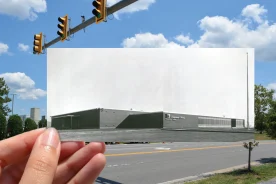
As a community development financial institution (CDFI), Freedom First, which recently built a new branch on Patterson Avenue, is making significant contributions to the community with programs for low- and moderate-income home owners and first-time buyers. The city also offers an array of incentives to property owners interested in rehabilitating old homes.