Education is a calling for many, but for these Roanoke Valley families, it is a multigenerational legacy rooted in service and commitment to students.
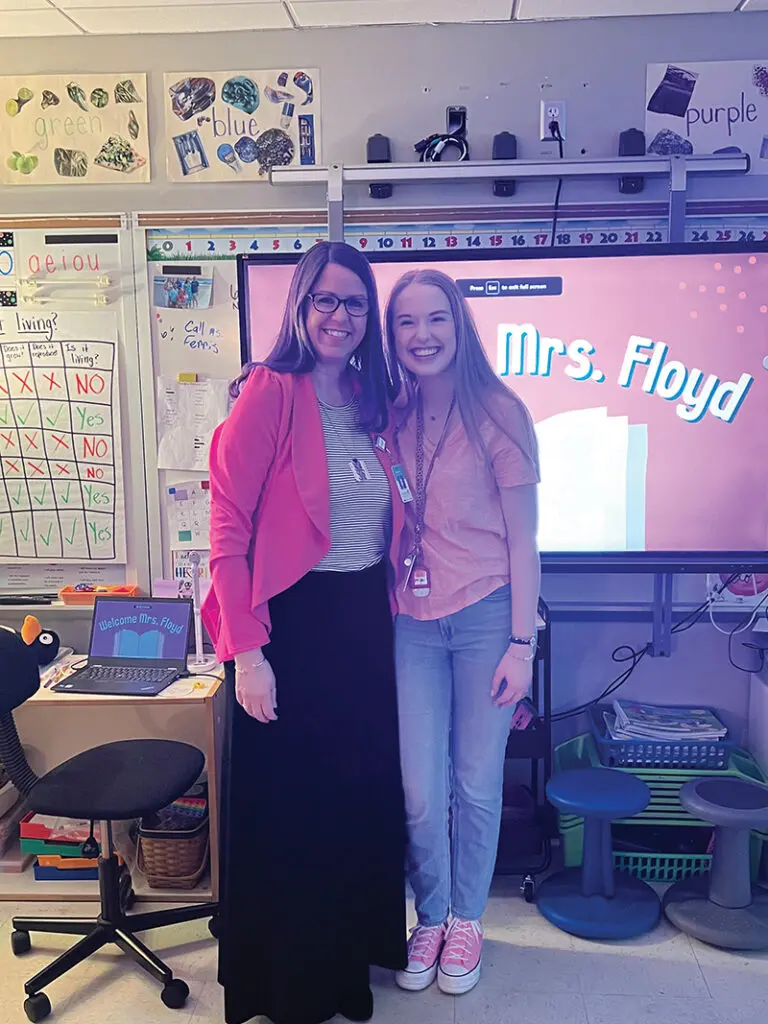
Written by Aila Boyd / Photo Above: Megan Sutphin and Tami Molnar. Courtesy of Megan Sutphin
While most educators treat teaching as a career, some Roanoke Valley families prove that teaching is a legacy that has been passed down from grandparents to parents and from parents to children.

The profession has changed over the years, but the reason these families in Roanoke, Salem, and Botetourt County have continued to show up has remained the same.
“Education is a calling,” said Jesse Truax Sr., whose family has spanned multiple generations in Roanoke City Public Schools. “It demands dedication, discipline, and determination. Without these, you won’t be successful, nor will you stay in this career for long.”
Truax came to education later in life, leaving the business world after his wife, Anne, and her parents persuaded him to pursue teaching. Anne’s mother, Mary Fink, taught elementary school in Dallas in the late 1950s and into the 1960s before going on to teach in Liberty University’s education department and supervise student teachers. The Truax children followed: their son, Jesse Jr., left the construction industry to join Roanoke City Public Schools, and their daughter, Kristen, became a school counseling coordinator in Charlotte-Mecklenburg Schools in North Carolina.
“Having spent a huge portion of my life in a family of educators, I have realized the influence teachers have on a student’s attitude, achievements, and aspirations,” Truax said.

Deep Roots
For the Bell family of Roanoke City, the roots run even deeper—more than a century into the city’s past. Jordan Bell traced the family’s connection to Roanoke to the early 1900s, when their great-grandmother, Robbie Board, settled in a city that was still taking shape.
“Robbie never received her high school diploma because when she was 18, there was no accredited high school for African Americans in Roanoke,” Jordan Bell said. “Harrison School became accredited after she left school. She laid the foundation for our family to be what it is today in Roanoke.”
The Bells’ late father became the family’s first educator, eventually serving as assistant principal and then principal of Hurt Park Elementary School. His four children—Ryan, Jordan, Kiana, and their mother, Kathryn—have each carved paths inside Roanoke City Public Schools and beyond.
Ryan Bell described the philosophy that has come to define his family’s approach: love and accountability, held in balance.
“Love without accountability can lower expectations, while accountability without love can diminish dignity,” Ryan Bell said. “The balance of both is where transformation happens.”
That balance was modeled, the family says, not only in school buildings but in community spaces. Ryan Bell pointed to the work of an uncle, Larry, who drove a school bus in Los Angeles for more than 30 years and understood that his role was never merely transportation.
“He understood that he was often the first and last experience a child had with school each day,” Ryan Bell said, “and he approached that responsibility with both love and accountability.”
Kiana Bell credited the family’s outlook to lessons that extended well beyond the classroom walls. “My grandmother had little formal education but moved her family from Georgia to California for better opportunities,” she said. “Her sacrifice showed me the value of education across generations.”
Establishing a Legacy in Salem
In Salem, a different family legacy stretches back to the first days of the city’s school division. Forest Jones Sr. helped establish the Salem City School Division in 1983, also serving as city manager. His wife, Betty, spent decades as a classroom teacher. Both traced their own inspiration to the educators who shaped them.
“My first-grade teacher was wonderful,” Betty Jones said. “She inspired me and taught me how to read.”
Their sons, Forest Jr. and Anton, each found their way into education—and each faced their own version of the profession’s defining challenges. Forest Jones Sr. and Betty Jones began their careers in the mid-1960s, helping integrate schools in Lynchburg and Campbell County as some of the first Black teachers in those newly integrated buildings.
“They helped integrate schools in Lynchburg and Campbell County and were some of the first Black teachers in those integrated schools,” Forest Jones Jr. said. “I wanted to teach and coach because of both of them.”
Forest Jones Jr., who earned a doctorate and rose through Salem City Schools to serve as a principal, teacher, and central office administrator before retiring, said the profession’s core challenges have persisted even as their forms have changed.
“My parents had the challenge of being some of the first Black teachers to teach in integrated schools,” he said. “My challenge was continuing to get more and more kids whose needs were many, and the number of kids who lived in poverty increased.”
Anton Jones, a teacher and coach at Andrew Lewis Middle School and a Salem High graduate, echoed that view. “I imagine that my parents’ biggest challenge was teaching through integration, while I’d say that my generation’s biggest challenge was teaching through a pandemic,” he said. “I think that, while both situations are very different, it took time in both situations to get back to some sense of normalcy in school.”
Anton Jones said he still carries advice his parents gave him—and it has little to do with curriculum. “My parents have often reminded us that students are going to remember their experience in a classroom more than the math, the science, the reading, or the history.”
Side by Side
For Megan Sutphin, a speech-language pathologist at Colonial Elementary in Botetourt County, the family calling expressed itself in an unusual way: She now works in the same building as her mother, Tami Molnar, a veteran classroom teacher.
Sutphin initially steered away from teaching in part because her mother encouraged her to reconsider. “Teaching is not what it used to be,” Sutphin said her mother cautioned her, citing increased technology, outside mandates, and a shift in parenting norms. Sutphin pursued speech pathology instead, but the pull toward schools proved irresistible.
“Not only did I follow in my mom’s footsteps as a public educator but I have the opportunity of working right alongside her every day,” Sutphin said.
She described the core value her grandmother, mother, and she have shared across three generations of educators: respect and love. Her mother ends each school day by signing “I love you” to every student in sign language. Former students still return the gesture when they pass her in the hallway.
“All kids just want to be loved,” Sutphin said. “I fully believe wholeheartedly that you can’t be an educator or in the field of education without showing love or having love in your heart for these students. Because for some of them, you may be the only one who tells them that.”

Changing Classrooms
With long memories come unique insights into how the profession has changed over the years.
Rachel Floyd, supervisor of reading improvement for Roanoke City Public Schools, pointed to a fundamental shift in how literacy is taught. “The biggest change in education has been the shift to literacy practices aligned with the science of reading,” Floyd said.
Her daughter, Kacey Day, now a kindergarten teacher at Burlington Elementary in Roanoke County, was herself educated under the older balanced-literacy approach that did not emphasize explicit, systematic reading instruction.
“We both share a passion for providing a strong literacy foundation for students,” Floyd said. “The ability to read and process written information can unlock so many opportunities in the life of a child.”
Chris King, a retired athletic director and current Salem City School Board member, put the technology shift in sharp relief. “I began my educational career in the fall of 1990,” King said. “The changes in the profession in the last 35 years have been generational—from technology, social media, curriculum, the family unit, and society in general.”
King noted that he had followed a path remarkably parallel to that of his father-in-law, Dale Foster, a revered coach, teacher, and athletic director who served at Andrew Lewis High School and Salem High School. Both men held the same positions—assistant principal and athletic director—at both schools.
King’s wife, Jenny, a fifth-grade teacher at East Salem Elementary, said the pull toward teaching began in childhood. “As a child, most of my days, if I wasn’t outside playing, I was pretend teaching in my basement with my mom’s textbooks,” she said.
Their daughter, Christen King, a fifth-grade teacher at West Salem Elementary, described a similar upbringing. “Growing up with my mom and dad in the education field definitely helped shape me as a teacher and my views on learning.”
Getting her own teaching job in Salem carried a particular meaning. “I was so excited to be a part of Salem City Schools, the place where my dad, mom, granddaddy, and granny all taught,” she said.
“It gives me a sincere feeling of pride to follow in my father-in-law’s footsteps, to see students I taught 30 years ago still call me ‘coach’ when I see them out in the community, and to run into people in the grocery store and they tell me how their kids love having my wife or daughter as their teachers,” Chris King said.
A Legacy That Continues
Instead of measuring the impact of their work through standardized test scores, these families live for the smaller moments.
“I always find it meaningful when former students and former coworkers of my father are brought to my attention,” Jordan Bell said. “When people speak about his impact on them and how kind he was to them. We miss him very much.”
Kathryn Bell, the family’s matriarch, described the weight and the gift of belonging to such a lineage. “For our family, education has never just been a profession—it has been a shared calling rooted in service, commitment, and belief in the power of learning to change lives,” she said.
Sutphin put it in more personal terms, thinking about the school year ahead and the three generations her family might one day share under one roof—herself, her mother, and her young son, who is still a few years from kindergarten.
“It’s an honor to come from a family who has poured their heart and soul into the lives of others,” she said. “It’s an underpaid, overlooked, and often times underappreciated job—but it’s one of the most important ones.”
The story above first appeared in our July/August 2026 issue.