Virginia hospitals and clinics are nervous with good reasons these days. Medicaid and Medicare are under fire.
Written by Dan Smith
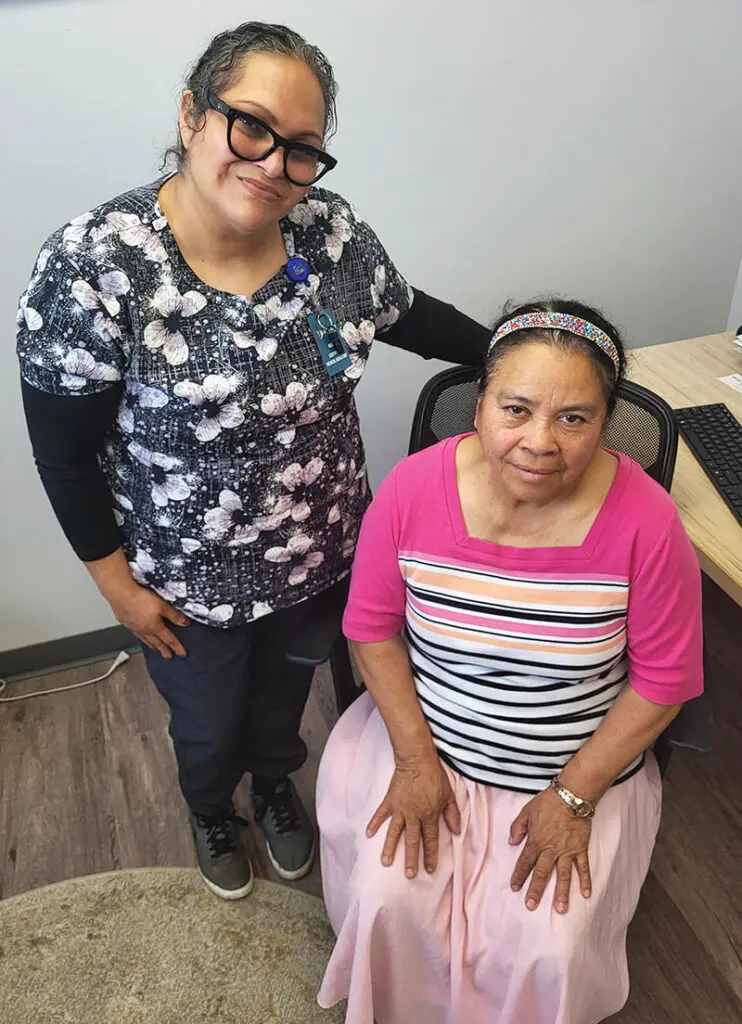
Aging Maria Rodriguez came from Honduras to Roanoke nine years ago to live with her children and grandchildren. She has resident status now and she is eligible for health care at the Bradley Free Clinic, one of 70 free clinics in Virginia. Bradley serves 4,000 patients, a number that has more than doubled in the past three years. Its services are stretched nearly to their limit.
Rodriguez has the typical medical issues of a woman of 69, but without the clinic, she likely would go untreated. Medicaid pays for her care. “In the beginning,” she said through interpreter Rosa Martinez, who works at the clinic, “I got a lot of testing, which I couldn’t get done before.” The professionals at the clinic applied for Medicaid for Rodriguez.
Medicaid is under attack these days and she is “nervous, a lot of daily stress. It makes me feel worse.” She has recently had an MRI and a mammogram. The staff at the clinic “helps her read instructions,” says Martinez. She also gets free rides to the clinic.
“Everybody here is so precious and generous,” said Rodriguez. “They treat me with respect. I love it here. I have recommended it to so many people.”
Janine Underwood, Executive Director of the Bradley Free Clinic in Roanoke, said, “We are the medical home for our patients.” That means complete care: labs, dental, vision, physical therapy, pharmacy and psychiatry/psychology. The clinic has 35 employees, 250 volunteers, and a $3.5 million annual budget, according to Underwood.
The clinic receives a variety of grants (60% of its funding), donations (25%) and various in-kind services (about 10%). “We are looking for more sources,” said Underwood, “but it puts a strain on donors. It is becoming increasingly difficult.”
Underwood has a prominent sign in her office that reads, succinctly, “We Will Figure It Out.” She said, “That has been increasingly difficult to do the last couple of years.”
In addition to changes in Medicare and the ACA, inflation has had a negative effect on the clinic. “There are more complex issues,” she said. If patients are turned away, “they go to the [emergency room],” which puts heavy pressure on the hospitals in the area. “We are the safety net in the healthcare system for low income, uninsured people. If hospitals close, patients will want to go to free clinics. We are already at capacity.”
Underwood pointed out that “one of the things we do is get people back into the workforce,” thus positively affecting the local economy. “We are trying to collaborate with other agencies, to pool our resources.”
Registering patients doesn’t mean they will be seen, stressed Underwood. “We are seeing waitlists climb. We are registering patients faster than we can see them. Only 58% of the patients we registered July to December [of 2025] were able to be seen. The others are on waitlists.”
In the next 24 months, Underwood says, patients “will come in waves” because “an estimated 300,000 Virginians [will be losing] their health insurance due to federal policy changes.”
New Horizon in Roanoke is one alternative, but “they have a sliding scale,” she said, “and we are free. They are federally funded and we are not. We need New Horizon and we need the clinic.”
Bradley Free Clinic board member Todd Marcum points to another key element: Federally Qualified Health Centers (FQHCs) are nonprofit, community-based healthcare providers that deliver comprehensive primary care—including medical, dental, and behavioral health services—to underserved populations, regardless of a patient’s ability to pay. New Horizons in Roanoke is a good example. “They receive federal grant funding through the Health Resources and Services Administration (HRSA) and enhanced reimbursement from Medicaid and Medicare, allowing them to offer care on a sliding fee scale and operate as a critical safety net, particularly in rural and medically underserved areas,” said Marcum.
More than 400,000 residents in Virginia rely on these centers as their primary source of care, often because few or no alternatives exist. The system is highly dependent on stable federal funding. Recent delays, cuts, and disruptions to federal grants and Medicaid funding have forced some Virginia health centers to scale back services or even close locations, creating immediate gaps in access to care.
“In Southwest Virginia—where geography, workforce shortages, and higher rates of chronic illness already strain the healthcare system—these funding challenges can mean longer travel times, fewer providers, and increased reliance on hospital emergency rooms,” Marcum said. “In practical terms, federal funding instability doesn’t just affect clinics—it directly impacts whether thousands of individuals and families can access timely, affordable healthcare in their own communities.”

Following the closing of several health care facilities in the Shenandoah Valley a few months ago (Buena Vista, Churchville, and Weyers Cave), a report identified 10 Virginia hospitals as being at risk. They included Carilion’s Tazewell Community and other hospitals in Grundy, Galax, Clintwood, South Boston, Farmville, Tappahannock, Emporia, Woodbridge, and South Hill, all rural facilities
In an official statement via email, Carilion senior consultant Pete Larkin replied, “Carilion’s mission is to improve the health of the communities we serve. Like all nonprofit hospitals, we’re accustomed to tight operating margins in caring for patients in our communities. We’re careful stewards of our resources, and we’ll continue working hard to be efficient and thoughtful about carrying out our mission to invest in the community’s long-term health.”
Carilion recently opened the $500 million Crystal Spring Tower in South Roanoke. The 12-story, 500,000-square-foot building houses an expanded emergency department, a Level 1 trauma center and a cardiovascular institute.
Farmville’s Centra Southside Community Hospital recently closed labor and delivery and OBGYN surgical services, and its outpatient care with its affiliated women’s center. The reason given: it “must adapt to significant financial and operational challenges, including recently enacted reductions in federal health care funding.”
Julian Walker, Vice President of Communications for the Virginia Hospital & Healthcare Association, which represents 117 hospitals and 26 health systems across Virginia, points out that Medicare/Medicaid reimbursement is 72% and Medicare is 78-80%. Both are below cost of delivering service.
Obamacare (ACA) “did Medicaid expansion,” said Walker. HR1 (Trump’s “Big Beautiful Bill”) cut Medicaid by $1 trillion over 10 years. Projections of full implementation would cost $2 billion in lost funding for hospitals. Ten million nationally lose coverage.
“We project $2 million a year loss for hospitals,” said Walker. “Under [HR1] there are work requirements. Virginia would have to go through implementation again. If the feds go below 90-10 [compensation], Virginia expansion would be withdrawn. Virginia would walk away if it changes.”
Still, said Walker, “I can’t say hospital closings will happen. Seventy-three percent [of payment is in] Medicare/Medicaid in rural hospitals. Rural margins are slim. Some run in red year after year. Many have cross-subsidization. Rural hospitals in Virginia run the risk, face financial challenges already: They are smaller, sicker, poorer, and heavily reliant on Medicare/Medicaid. And it is hard to recruit specialties. Some say it is death by a thousand cuts.”
Congressman Don Beyer said, “Over a billion dollars in federal Medicaid reductions over a decade is expected to result in roughly 350,000 Virginians losing coverage and potentially cause over $26 billion in lost federal payments for Virginia’s healthcare facilities over 14 years, worsening financial instability.”
There are alternatives now, some of them quite good, but underfunded. In the near future that could be a distant memory of a better time.
The story above first appeared in our July/August 2026 issue.