In 1913, Roanoke was divided by racial segregation, so black doctors did not have surgical privileges in the local white hospitals and local African-American citizens could not take advantage of medical facilities. When three of Roanoke’s black doctors made history by performing the first major surgical operation by African-Americans in Southwestern Virginia, it was performed in a private residence. They were frustrated by the lack of access to modern sterilizers, operating tables, adequate lighting, telephone communication, and trained nurses.
But several black physicians in the area, including Dr. Issac David Burrell, were working diligently to establish a hospital for black residents. In the midst of these efforts, Dr. Burrell became seriously ill with gallstones and was forced to travel in a train baggage car to Washington, D.C. for treatment. He died following surgery, and the heart-wrenching circumstances of his death served as a catalyst to ensure that this tragedy would not be repeated for another black person.
On March 18, 1915, Burrell Memorial Hospital, named in honor of Dr. Burrell, opened at 311 Henry Street. It began as a 10-bed facility equipped with $1,000 of borrowed money but went on to become the first African-American hospital to earn full approval of the American Board of Surgeons. Dr. Lylburn C. Downing, who had been the first African-American accepted as a member of the Roanoke Medical Society, became the first superintendent and held that position until 1947.
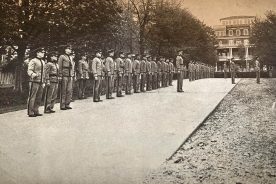
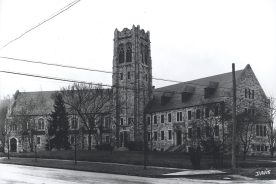
The flu epidemic of 1919 created the need for expanded facilities, so the hospital moved into the abandoned Allegheny Institute building on the corner of McDowell Avenue and Park Street (now 7th Street) in 1921. This building was used until 1955 when the present hospital was opened.
Burrell Memorial Hospital remained a prominent black institution until the 1965 Civil Rights Act mandated the desegregation of hospital facilities. In 1979, the hospital closed. Today, The Burrell Center is home to Blue Ridge Behavioral Healthcare.
More from 1915:
• The Evergreen Development Company announced the purchase of 47 acres in the Raleigh Court area for the purpose of creating a burial park.
• Booker T. Washington, educator, author and leader of the African-American community nationwide, died Nov. 14, 1915. He was born a slave in Franklin County.
• In December 1915, Mill Mountain and South Roanoke were annexed to the City from Roanoke County.
New Life for a Middle-aged Building
Today the c.1955 Burrell Hospital building is known as The Burrell Center, and houses many of the adult service programs of Blue Ridge Behavioral Healthcare, one of 40 Virginia Community Services Boards providing comprehensive services for individuals who have mental health disorders, intellectual disability, or substance use disorders. BRBH operates multiple programs with more than 400 employees.
In 2003 BRBH completed a renovation that preserved much of the former hospital’s design, including terrazzo floors at the former nurses’ stations, wide hallways and solid patient room doors, many retaining the small observation window common in the past. A few employees report that they were born in the building, but the building’s historical significance and its importance to the neighborhood are recognized by all who enter via a multi-panel display in the lobby of old photographs and text that tells the story of the prominent role Burrell Hospital played in the past.