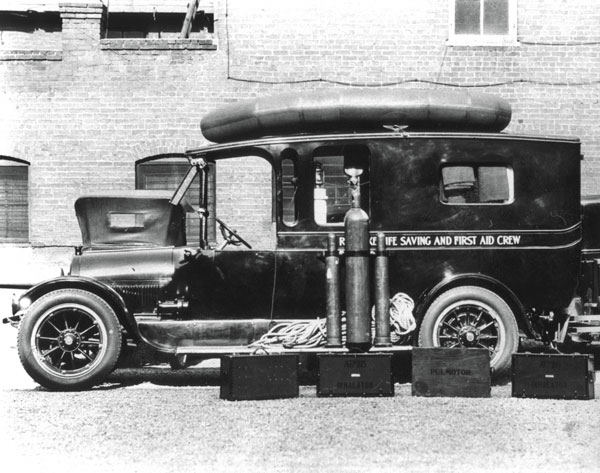
Julian Stanley Wise, acting on a boyhood trauma along the Roanoke River, founded the nation’s first rescue squad.
It’s one of the little legendary occurrences of Roanoke history, beginning in 1909 when the nine-year-old Julian Stanley Wise was walking along the Roanoke River and saw two men fall out of a canoe and drown.
In 1928, when Wise was 28, he acted on the scar the accident had left in him by forming the first volunteer rescue squad in the country. The Roanoke Life Saving and First Aid Crew was founded by Wise and nine fellow Norfolk & Western employees.
Wise helped equip and fund his operation with a stunt, staging the “drowning” of a 250-pound dummy in a pond. As a result he got communictions support from the city and an old ambulance from a funeral home. He would remain involved with the crew, as captain and president, for at least 50 years.
A much bigger pond than Wise used was about to come into being in 1928, with the completion of the dam that would hold Carvins Cove Reservoir. But not unlike Wise needing some time to get things up and running, the drought of 1929 slowed the filling of the lake, as did land acquisition, which would combine to delay first full pond until 1946.
Other random notes from 1928, courtesy of the quirky “History of The City of Roanoke,” by Raymond Barnes:
• In February, a law enforcement vehicle was blown up as it was parked for the night. The car had been seized from bootleggers and put into use by the feds beause of its speed. “Destroying fast cars used by law enforcement officers was becoming quite popular,” Barnes writes.
• The American Theater opened in March to a huge crowd paying at least $10 a ticket and with proceeds going to the Lions, Ruritan and Kiwanis clubs for use with “crippled or diseased children.” Later in the year, the first “full-sound” movie (not to be confused with a “talking” movie) in Roanoke played at the theater – “Our Dancing Daughters,” starring Joan Crawford.
• A 17-mile stretch of what is likely now U.S. 460 between Roanoke and Bedford was paved, allowing for celebration that for the first time, it was possible to travel on hard-surface roads from Roanoke to Norfolk.
• Historian Barnes reacted to the high point of the “flapper” era with a bit of a patriarchal air: “One thing for certain,” he wrote of 1928, “the dresses were so short, girls, for modesty’s sake, were forced to wear bloomers.” And later in his coverage of the year: “Brides wearing a short dress with a kind of train or veil suspended from their heads, did not look like a conventional bride.”
Mayors: They always want the same ol’ things
Roanoke Mayor C. D. Fox in 1928 outlined four major areas of need for the city:
- A municipal stadium to seat at least 20,000.
- An airport (the location for which would be secured in July of 1929).
- Widened streets to accommodate traffic.
- Better highways from outlying areas into the city.
- Perhaps it is more a function of the municipality as an entity than it is the predilections of mayors, but how much has that list changed over the years since?
- How far – in concept and in goal – from a municipal stadium is a regional amphitheater?
- And how much distance is there between the need for an airport and the need for better service at the airport?
- The widening trend has reversed somewhat in recent years, with some streets – Grandin Road and Bullitt Avenue (Southeast) for example – undergoing narrowings to accommodate calmer, slower traffic. And at least some of the plea for better travel through the city has shifted from the context of paved roads for cars to paved greenways for foot and bicycle travel.
- I-73 has been back in the news of late, with its years-away promise of delivering commerce from the directions of Detroit and Charleston, S.C. into the valley (and likely through the city).