Buildings are just buildings when you drive by them. Get out of the car and walk by them, though, and they take on a whole new personality. They project a beauty through architectural design and diversity, and tell a vivid history of where a town has been and even where it is headed. Such a thing happens when you take a walk through historic downtown Salem.
Like Roanoke, the Salem area was first seen by European explorers Thomas Batts and Robert Fallem in 1671. Settlers soon began to move into the area, and Fort Lewis was established in 1752 to protect them from attacks by Native Americans. By the early 1800s, the town was well established, with dozens of businesses catering to new pioneers who were traveling through the Great Valley of Virginia on their way to points farther west.
Begin the walking tour at the Williams–Brown House–Store at 801 East Main Street, built as the residence of William C. Williams before the 1850s and used as a store and post office. It is now the Salem Museum, which is well worth a step inside to take in displays by the Salem Historical Society. Also pick up a copy of the Salem, Virginia: A Historic Walking Tour brochure that will supplement the limited information I’m able to supply in this short column.
Diagonally across the street is Old Manse, built by a blacksmith in 1847, and used as the minister’s home by the Salem Presbyterian Church until 1939. If you have kids with you, consider making a short detour into Longwood Park to let them enjoy the playground.
The Old Courthouse in the 300 block of East Main Street was completed in 1910, a year after the Southern Cross Chapter of the United Daughters of the Confederacy dedicated the Confederate Monument on the front lawn.
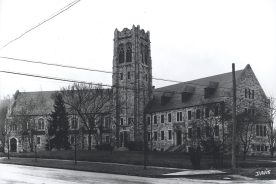
Step across College Avenue and come into the commercial district where, if you are a shopaholic, you may not be able to resist aisles and shelves of clothing, gift items, paintings and furnishings. Many of the storefronts are original and retain decorative tinwork from the turn of the 20th century. One of downtown Salem’s most interesting historical tidbits is that the Presbyterian Church at Main and Market Streets was built in the 1850s, using slave labor and bricks manufactured on site.
If the weather is cool, slip into Mill Mountain to warm up with a cup of coffee. If it’s hot, cool off with a frozen frappe and continue on your way, maybe grabbing a baked good or fresh fruit as you walk by the Farmer’s Market. Go one more block and turn right onto Academy Street to the imposing buildings of the former Academy Street School. Housed in Italian–style Flemish Bond structures, this was Salem’s first public school and operated from 1872 to 1977.
A right onto Clay Street and a left onto Broad Street take you past the Jefferson–style Revival City Hall, originally built in 1912 as Salem High School. Beyond this columned building is one of Salem’s quiet, tree–lined neighborhoods. Walk as far as you want, at least into the next block, and wander by late–1800s homes decorated with carved wood cornices and eaves, cast iron windows, and Corinthian columns.
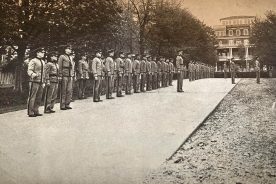
Return to Clay Street, turn left, and saunter into Roanoke College in the middle of the next block. Originally established in Augusta County in 1842, the college was moved to this site in 1847. The Administration Building, directly in front of you via the brick walkway, was completed in 1848. Ponder the generations of students that have passed through this institution: What was dorm life like in Chalmers Hall in the 1930s? What topics of the day have been discussed in Miller Hall, the college’s second oldest building?
Leave the campus by turning right onto High Street. Make a left onto Clay Street, a right onto Thompson Memorial Dive and another left onto East Main Street to retrace the route back to your automobile.
Information
Getting there: Drive I–581 north, turn south on I–81, take the second exit (Exit 140), and go south on Va 311 for 1.6 miles. Make a left onto East Main Street and continue for another 0.8 mile to leave your car in the Salem Museum parking lot on the left.
Total length: 2.5 miles
Difficulty: Easy
Nearby after-hike treat: One of the area’s most innovative restaurants, Michele’s on Main, is in the old Post Office at 103 East Main Street. Enjoy a wonderfully delicious meal or, at the least, one of their great desserts.