The story below is from our January/February 2023 issue. For more stories like it, Subscribe Today. Thank you!
Our iconic skyline has quite the history.
Editor’s Note: You can listen in to more of this feature and how it came about thanks to our podcast! Our second episode’s first segment with Mason Adams details more about our iconic skyline. Listen to the podcast now, or the individual segment below.
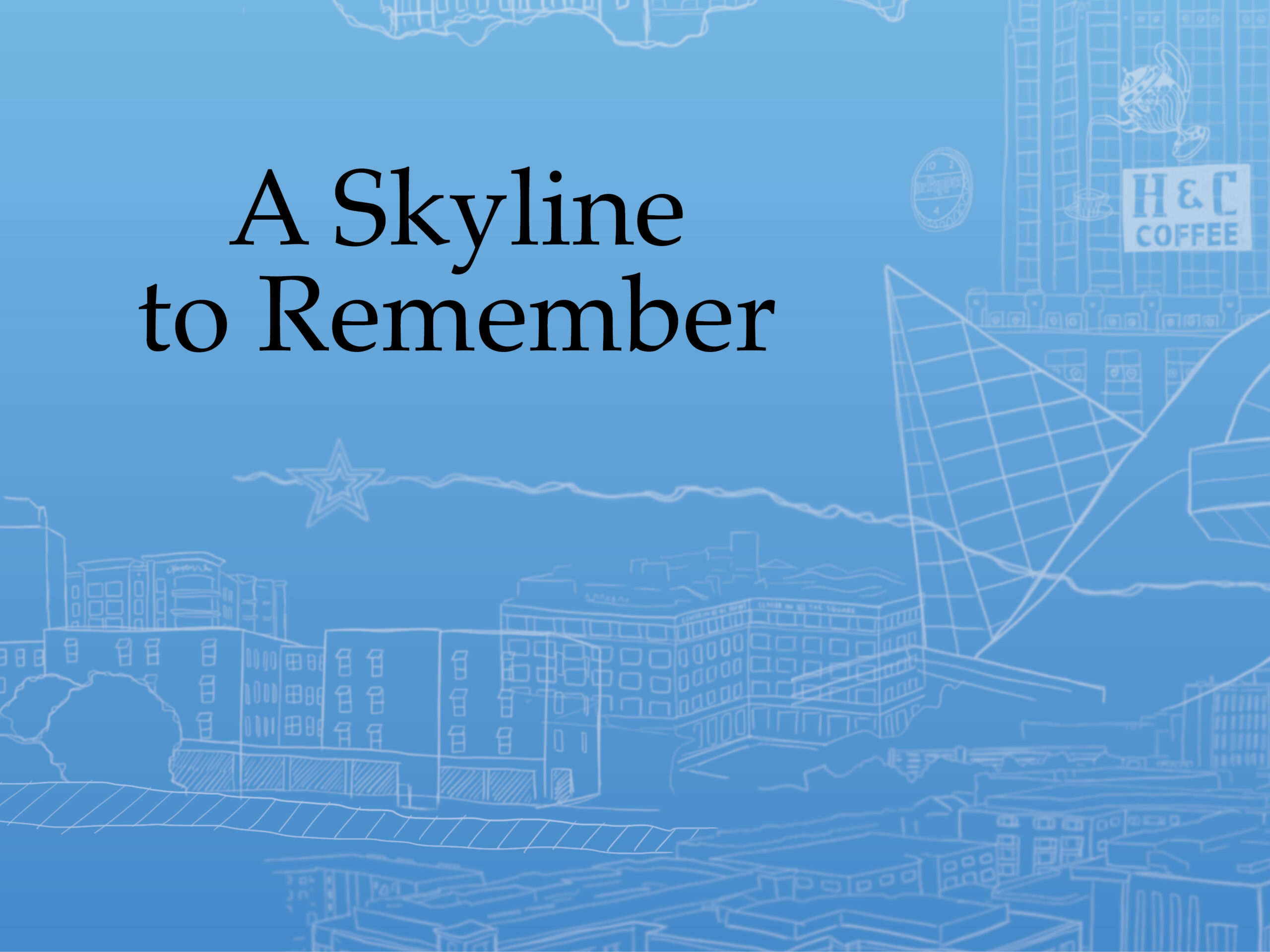
Downtown Roanoke buildings have strained skyward for nearly 150 years, eventually growing to encompass the skyline itself.
Buildings have risen, aged, been redeveloped and joined by newcomers. They’ve shaped the way Roanokers think about the city, its history and its future. All these structures stand against Roanoke’s most ancient bit of skyline — Mill Mountain.
Every Roanoke neighborhood has its own distinctive skyline. But downtown Roanoke is the city’s collective neighborhood — the place where Roanokers of all walks of life come together to eat, drink and celebrate life in the Star City. That’s still true even as downtown becomes a real neighborhood for a growing number of people living in redeveloped office buildings, warehouses and auto dealerships.
Downtown Roanoke’s skyline shapes the horizon and our conception of what Roanoke is. The skyline reflects the collective dreams of everyone who lives in the broader metro region.
Beginning with the opening of the Norfolk & Western railroad shops in 1883, entrepreneurs, developers and other visionaries shaped Roanoke’s buildings, which in turn fired the imaginations of residents. They inform our collective imagination about what Roanoke is and what it can be.
St. Andrew’s Catholic Church rose in the early 1900s, flashing as a signifier for Lebanese, Greek and Black migrants flocking to Roanoke for railroad jobs. The church’s High Victorian Gothic architectural style contrasts with the Tudor Revival style of its longtime neighbor, the Hotel Roanoke. The two established an early pattern of differing architectural styles nestled next to one another that continues throughout downtown Roanoke. Often these differences stem largely from when they were built.

“All those two-story, three-story buildings are your oldest ones,” says Roanoke architect Alison Blanton. “They didn’t have the elevator and telephone yet, and you didn’t want to run down from the 8th floor every time you needed to talk to someone. Then Roanoke has an amazing amount of mid-century modern architecture. And now we are back to building, which says volumes about Roanoke’s growth and economy.”
Roanoke’s sometimes jarring architectural contrasts can provoke strong opinions, especially when buildings are still new. The Taubman Museum of Art’s wavy lines and sharp angles provoked bemusement and even mockery when first unveiled in 2005. That initial reaction has largely given way to affection due to how the museum frames the rest of downtown.
The H&C Coffee and Dr. Pepper signs move through periods of decay and restoration but have become vital parts of the downtown vibe. Developer Aaron Ewert has had a close perspective on downtown. His father former city manager Bern Ewert was a key part of the Design ’79 initiative that revitalized the Market Building and Center in the Square. Aaron Ewert was an early downtown resident, living above Billy’s Ritz. He proposed to his wife beneath the H&C Coffee sign on the building’s roof.
Roanoke skyscrapers rose into the ‘90s. The Dominion Tower became the First Union Tower became the Wachovia Tower became the Wells-Fargo Tower as banks devoured each other.
Most of us look backward in time through our memories. I remember Campbell Court before Valley Metro moved and the building was demolished, but I can’t imagine Roanoke before urban renewal. My lack of memory and imagination precludes me from being able to look at Gainsboro and imagine dozens of blocks of neighborhoods before they were demolished for the civic center and I-581.
Some developers can look into the future and see what’s to come. Lucas Thornton envisioned three-story buildings squaring up to Williamson Road, and made it reality with Gramercy Row. He now looks at empty parking lots along Jefferson Street, and sees them full of multi-story buildings.
Downtown stretched south with the Virginia Tech Carilion School of Medicine and Fralin Biomedical Research Institute. The Bridges provided new residential and commercial development on the other side of Jefferson Street.
Carilion Clinic CEO Nancy Agee says downtown’s shifting profile was front of mind when Carilion officials chose green-tinted glass for windows on Roanoke Memorial Hospital’s South Pavilion, which sits against Mill Mountain.
“We had the idea that glass would be a constant picture,” Agee says, “reflective of all that’s going on and reflective of movement and progress.”
On one Sunday evening, that reflection included soccer players sprinting across a field, a steady stream of walkers, bikers and runners on the greenway and a medical helicopter landing on the hospital’s rooftop helipad.
Downtown buildings stretch upward from the city like mythological gods. Here, of course, you can actually walk or drive up Roanoke’s version of Mount Olympus.
And when you gaze down upon Roanoke from the Mill Mountain Star, what do you see?
The story above is from our January/February 2023 issue. For more stories like it, Subscribe Today. Thank you!