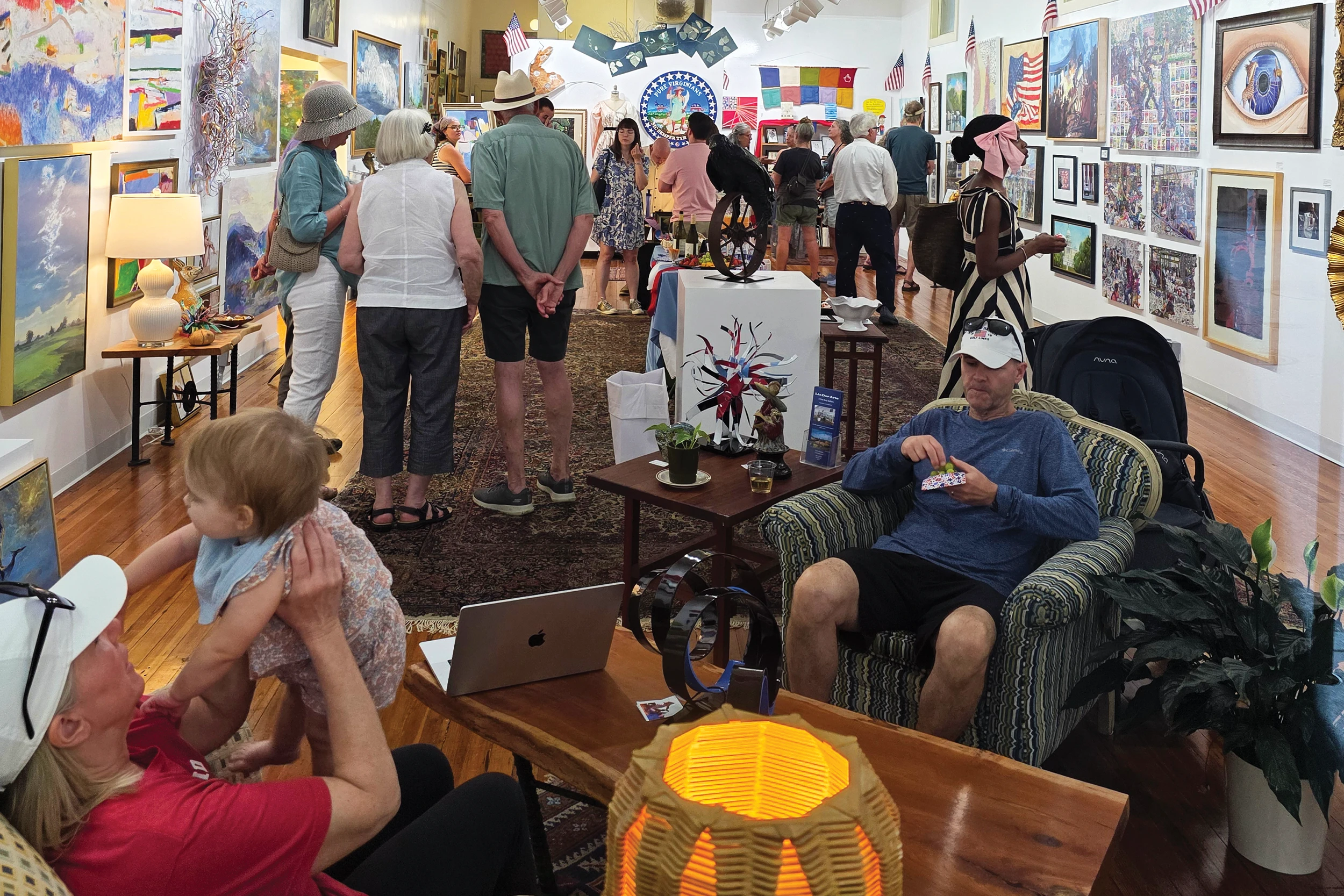
While Roanoke’s gems and restaurants get the most press, it has a vibrant art scene and artist community worth celebrating and supporting.
Written by Christy Rippel. Courtesy of Lindor Arts / Courtesy of Abby Hostetler
Roanoke has been a darling of late, collecting accolades in its virtual trophy case. CNN named it a top 10 town to visit in 2026, and it has drawn attention as an elite mountain biking and hiking destination. While its outdoor gems and restaurants get the most press, it has a vibrant art scene and artist community worth celebrating and supporting.
A centerpiece of the art community is the renowned Taubman Museum of Art, which anchors the downtown. “The Taubman brings people and art together for discovery and enjoyment, as well as curiosity and community,” said executive director Cindy Peteresen. In addition to its permanent collection and rotating exhibits, the museum features local artists and spotlights them during the annual Sidewalk Art Show in May. The show, in its 68th year, highlighted 140 local and regional artists who showed their work and offered it for sale.
While the Sidewalk Art Show is the signature local artist event, area galleries show and sell local artists’ works, and smaller shows dot event calendars throughout the year. If you are dipping your toe in the world of local art and want to learn about the painters and sculptors who call Roanoke home or are considering jazzing up your walls with original works, here’s how you can get started.

Local Galleries Spotlight Talent
If you are involved in the art world in southwestern Virginia, you know the name Dorsey Taylor. Taylor and his wife Linda own LinDor Arts gallery, a short walk from the Taubman, and Taylor has been in the art and framing business for five decades.
“We live in a hub, in a mecca for art,” said Taylor. “We have an amazing selection of art that flows into the valley, and my job as a gallery owner is to see what will fit in, what will sell. I have some really good artists who are professionals in their field and make a living painting or creating, and what we carry is the best of their work.”
The gallery represents some of the region’s most successful artists, including Greg Osterhaus, Kyle Buckland, Denise Blanchard, Tracy Budd, Betty Branch, Ed Bordett, and many others.
Taylor aims to make art accessible and invites anyone in to browse and talk. “There are no rules about what you should choose, and we encourage people to buy what they like,” he explained. “We highly encourage people to take a piece home and try it before they commit to buying it.”
Another Roanoke gallery that focuses on regional artists is The Loft Gallery at Black Dog Salvage, halfway between downtown Roanoke and Grandin Village. Black Dog Salvage is well-known to Roanokers, and visitors flock to the warehouse to sift through the massive collection of architectural salvage, made famous by the TV show “Salvage Dawgs.”
Koiner Thomas, sister of co-owner Robert Kulp, heads The Loft Gallery. Black Dog began carrying local art more than 20 years ago, alongside custom furniture they created from salvaged pieces, and marketplace booths where local artisans sold their wares.
“During COVID, we had the time to re-evaluate our spaces, and the loft was a storage area,” explained Thomas. “It had great natural light, and we realized we could display an artist’s body of work, instead of a single piece. So we renovated it and it became The Loft Gallery.”
Thomas said the goal was to support local artists and carry a variety of mediums. She also encourages buyers to browse, and to find a piece that elicits an emotional response. Some of the prominent artists at the gallery include Janet Gillum, Brett LaGue, Michelle McDowell Smith, Mark Woody, Susan Bradbury, and many others.
In addition to LinDor Arts and The Loft Gallery, there are many other galleries and stores showing and selling works in Roanoke, including the Alexander/Heath Contemporary Gallery, the Market Gallery, The Little Gallery, and Present Thyme.

Decorating with Art
While buying what you love and trying a piece at home before buying is solid advice, even that can make you say, “Well, then what?” Abby Hostetler, owner of the interior design business Enhance, has some practical tips on how to integrate art into your home.
“Art is so personal that it’s the hardest thing to choose for someone else,” said Hostetler. “But a designer can be helpful in grouping art together and helping with issues of scale.”
Hostetler says the biggest mistake people make is hanging art too high, and that the center of the piece should be 57 to 60 inches from the floor, which is eye level for an average height person. If you are hanging art above a sofa or piece of furniture, a good guideline is to leave four to eight inches between the bottom of the canvas or frame and the top of the furniture.
Getting the scale correct when choosing furniture and art for a space is one of the hardest things to eyeball, so knowing what size you are looking for and carrying a tape measure while shopping is a designer secret. To master the scale when art is anchored by a piece of furniture, choose art that takes up two-thirds to three-quarters of your furniture length.
If you are trying to fill a large space with a small budget, Hostetler recommends a gallery wall. “The way I do groupings or galleries is to find pieces that feel united in some way,” she said. “They could be in the same palette or cover the same subject.”
When hanging the grouping, think of the pieces together as forming one piece of art, which is how you center the gallery. If you need the gallery to take up a 10×6 foot space, mark the space off with painter’s tape. Hang the largest piece first and go in with smaller pieces within your painter’s tape border.
For the novice collector, Roanoke galleries are a great place to learn about local artists and mediums and to buy art, as they carry everything from affordable unframed watercolors to large works worth thousands of dollars. Hostetler also recommends browsing local estate sales (find listings at estatesales.net) or buying art at consignment stores like Roanoke Exchange. Some artists, such as Maria Driscoll, offer affordable prints of local landmarks like the Mill Mountain Star and downtown scenes, so you can have a locally themed piece without a big investment.
Another Hostetler tip for making art in your home personal is to browse stores and markets in places you visit. “Every time I go on a trip, I pick up a piece from that locality so the art inside my home tells a story,” said Hostetler.
She noted that in places like Charleston, South Carolina, and Paris, France, she picked up street artists’ works for a bargain and had them framed later. “You can get something that is original, and while that artist may not be famous that work has meaning to you.”
The story above first appeared in our September/October 2026 issue.