The story below is from our March/April 2019 issue. For the full issue Subscribe today, view our FREE interactive digital edition or download our FREE iOS app!
Photo Courtesy Nelson Harris
Hundreds of women across the region came together for a 1947 parade that protested a surprising topic.
Some women in Roanoke did not like it, so they marched in protest. Their parade snaked from the municipal building east down Campbell Avenue, turned south on Jefferson Street, ending in Elmwood Park. What were these women protesting on an overcast Saturday in September 1947? Hemlines!
It all began with the Paris fashion house of Christian Dior that spring. During World War II, fabrics had been rationed. Men’s slacks and suit pants could not have cuffs, and women’s skirts and dresses were lifted to just below the knee. All of this was the result of war rationing. Even the high-waist, wide-legged pants worn by men as a common style of the 1930s and early 40s went to a more tapered look. With the end of rationing, the designers at Christian Dior decided women’s fashion could again embrace rich, long fabrics.
Dior had partnered with fashion designer Marcel Boussac, who created what became known as The New Look, a movement back to the S-shaped silhouette with longer skirts and cinched-in waists prominent in the pre-war era. This sleek look, enhanced by elbow-high gloves and trendy hats, was originally called “Corolle” by Dior, a French term meaning “circlet of flower petals.”
It was the editors of Harpers Bazaar that called it The New Look. Fashion writers raved. The Boussac design replaced the practical, boxy-looking designs of the war with what they argued was a return to a more refined, feminine style. So popular was the look with critics and designers, historians now claim that Dior’s Corolle line put Paris back at the center of international fashion, having been rivaled previously by New York and London during the war.
What excited the high-brow in the salons of Paris and New York did not play well in middle-class America. The “Little Below the Knees” Club movement started with model Bobbie Woodward in Dallas, Texas, who said, “Whoever dreamed up this fall’s gruesome styles have been reading too many historical novels.”
She was quickly joined by others, including Coco Channel. A woman in Georgia tried to catch a bus, had her long skirt caught in the door, and had to run beside the bus a city block before the driver realized what was happening. Soon, Little Below the Knees Clubs began forming across the United States. The women, valuing the higher hemlines for a variety of reasons, became known as LBKers.
The LBkers were not just protesting fashion. They were advocating an early form of women’s rights in the workplace. Some large businesses were demanding female employees wear the longer skirts, not because they knew anything of Dior’s runways in Paris but they thought the more modest look was professional. Thus, LBK Clubs got legs – literally.
Mrs. P.M. Dillon of Roanoke organized Roanoke’s LBK Club in the summer of 1947. She was soon joined by literally hundreds of other women from around the region, many of whom submitted petitions they had circulated at offices and factories to pre-empt any workplace regulations on feminine attire.
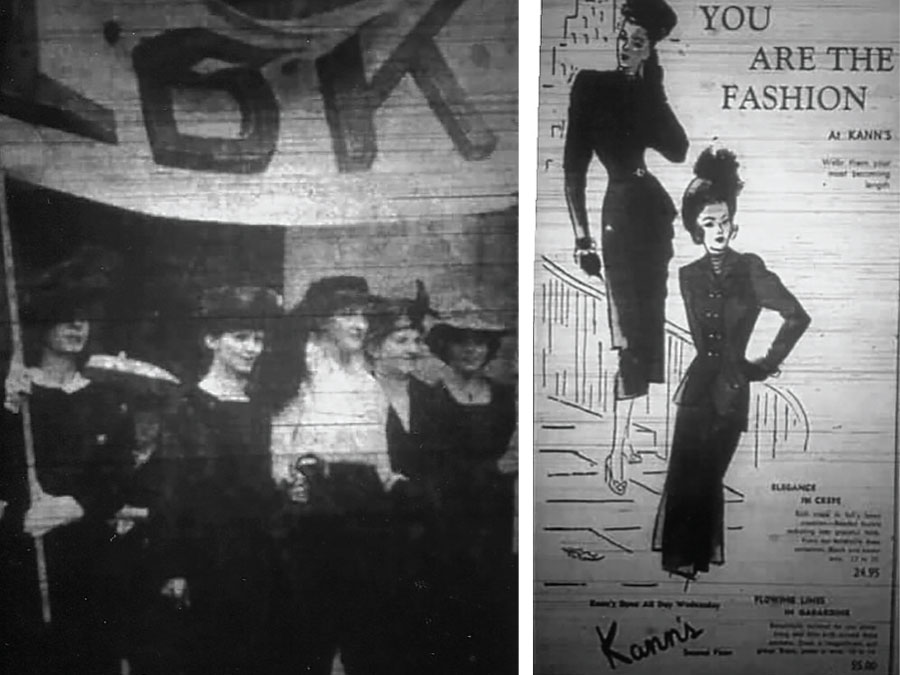
All this interest ultimately led to an LBK parade in Roanoke on September 6. Leading the procession was Dillon, Mrs. Clyde St. Clair, Mrs. J.W. Clemmer and five-year-old Susie Kaplan. They and the women who followed dressed in decades-old clothing, making the point that long skirts were for their grandmothers, not the modern woman. Two women, perched on a fire engine, paraded in bathing suits. Some one hundred women participated in the march.
A sound system, donated by Hobbie Brothers, pounded the message “Join the LBK today!” Kann’s, a local downtown dress shop, sponsored a float carrying LBKers wearing fashionable hemlines that conformed to LBK standards.
Aubrey Kessler drove a truck in the parade filled with men claiming to be members of the “League of Broke Husbands.” Nationally, the LBH was the male counterpart of the LBK, as husbands decried the expense of having to buy their wives entirely new wardrobes to conform to The New Look.
A downpour had delayed the start of the 3 p.m. event, but once it started, an estimated 7,000 spectators lined the parade route. The Roanoke Times reported, “Office workers hung out the windows and the crowd was as thick at Elmwood Park, where the parade disbanded, as it was at the municipal building, the assembling point.”
Among those watching were a group of young men encouraging young women to join what they called the LAK Club – “Little Above the Knee.”
Humor aside, Roanoke retailers were hedging their bets. A display ad in The Roanoke Times for Heironimus, that was holding its annual fall fashion show at the Hotel Roanoke later that week, read, “The hemline question isn’t just one of more inches, at all – skirt lengths will differ with the occasion, the fabric, the silhouette and – above all – you. Certainly in a season of such fashion variation, we believe it wise to choose your clothes at a store of sound fashion authority and standards of good taste.” Kann’s advertised “You are the fashion at Kann’s…wear them your most becoming length,” though the sketched models were all attired in The New Look.
The Roanoke LBKers not only paraded, but also petitioned. Among the documents collected by the informal group was a petition signed by 435 female employees at the Roanoke plant of the American Viscose against a possible lengthened hemline policy.
Roanoke’s parade was not unique. LBKers held parades in cities and towns throughout the United States. The short-lived LBK movement was part levity and part women’s rights in a post-war American workplace.
Over time, Marcel Boussac and Christian Dior won out. Their “Corolle” line of women’s fashion became widely accepted by the public and copied by leading designers throughout the 1950s. The LBK Club in Roanoke, like all in the nation, evaporated as actresses, models, magazine editors and female executives embraced the tea-length style re-birthed by a leading fashion house in post-war Paris.
The editors of Vogue correctly predicted at the time about Boussac and Dior’s new style, “There are moments when fashion changes fundamentally…This is one of those moments.”
Thus for one September Saturday in 1947 Roanoke had its own moment when women’s legs were not just the hit of the parade, they were the parade.
… for the rest of this story and more from our March/April 2019 issue, Subscribe today, view our FREE interactive digital edition or download our FREE iOS app!