Welcome to the fourth post in our Dog Training blog series. This ongoing series features guest posts by local professional dog trainers and highlights some of the big questions they address to their clients. Today’s post was written by Adam Miller of Big Dog Behavioral Dog Training.
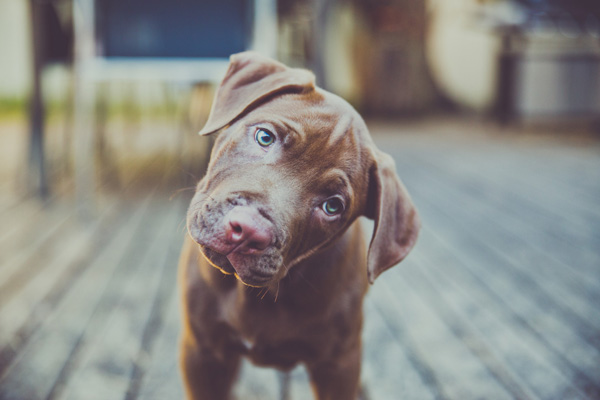
Consistent and correct communication is the key to training and relationship building with your dog. It is important to learn different ways to communicate with your dog so you can properly inform your dog whether you agree with or disagree with a behavior. The different techniques for communicating will allow you to convey your message to your dog in a way that it will better understand and comprehend. The easiest way to remember all the different communication methods is to look at your dog’s head – the different options are your dog’s nose, eyes, ears or mouth.
The nose represents scent or smell. Scent is a very powerful communicator…the way to a dog’s brain is through the nose. Scent is usually used for training purposes, for getting your dog’s attention or for redirecting your dog’s focus. Next time you lose your dog’s attention during training, just wave a tasty treat under your dog’s nose and you will see an immediate change of focus back onto you. Smell or scent can also be used to help calm your dog…the smell of lavender oil has a calming effect on animals (as well as humans) and can be placed on a bandana around your dog’s neck or underneath your dog’s bed.
The eyes represent communicating with your body language when interacting with your dog. A relaxed and erect posture communicates confidence and assertion. Your facial expressions can also be used to convey your feelings or intentions…pleasant facial expressions represent acceptance or approval and stern facial expressions represent dislike or disapproval. You can have a whole conversation with your dog by just using different facial expression. “Spatial pressure” is another technique that is used to get your point across to your dog. Spatial pressure is simply the act of moving in towards your dog or away from your dog. Moving in will back up a dog and is an assertive movement while moving away from your dog will invite the dog in and is an engaging movement. The next time your dog refuses to follow a command, instead of repeating it over and over, try taking a calm but assertive step in towards your dog.
The ears represent tone and sound. The tone in your voice when you interact with your dog is an easy way of conveying your feelings and thoughts. High pitch tones represent agreement or approval and low pitch tones represent disapproval and disappointment. Dogs naturally use tone when communicating with each other and it is a concept you can use which your dog will clearly understand. When a dog is happy, the pitch of their barking is higher and when they are upset, the pitch in their voice is lower. As for sound, it is also important that your dog learns the specific marks (or words) that you use when communicating with your dog. While your dog cannot understand much language, they can remember specific word sounds. There are two basics training marks that your dog needs to understand…your “praise” marks and your “correction” marks. Praise marks are the sounds that you use when you like or agree with a behavior…such as “yes” or “good”. Correction marks are the sounds that you make when you dislike or disagree with a behavior…such as “eh-eh” or “no”. Being consistent with your tones and sounds will greatly increase the speed in which your dog understands and learns.
The mouth represents touch. This is because dogs use their mouth to communicate by means of nips, muzzle-bumps or licks. Touch is a powerful communication tool and will override all other techniques…you will always get a response from your dog when you utilize touch. There are two types of touch – pleasant and unpleasant. Petting, messaging and scratching are examples of pleasant touch and leash corrections, bumps and pokes are examples of unpleasant touch. Dogs naturally touch each other in order to communicate so this is nothing new to them. The idea of the unpleasant touch is to simulate nipping your dog in order to let them know that you disagree with a behavior. The purpose of touch is to snap your dog out of its current state of mind and to get its attention back onto you.
Make sure to use all forms of communication – combine, alternate and balance the use of these tools to maintain motivation and focus. If you are not able to get your dog’s attention after a few attempts with one of the communication methods, then move on to another method. I compare being stuck in one type of communication tool with the definition of insanity…“doing the same thing over and over and expecting a different result”. Never rely on just one communication technique since it will desensitize your dog to that specific method.
This post was written by Adam Miller of Big Dog Canine Behavioral Training. For more information or to learn how Adam can help with your dog needs, contact him at bigdogcbt@gmail.com.