The story below is a preview from our September/October 2018 issue. For the full story Subscribe today, view our FREE interactive digital edition or download our FREE iOS app!
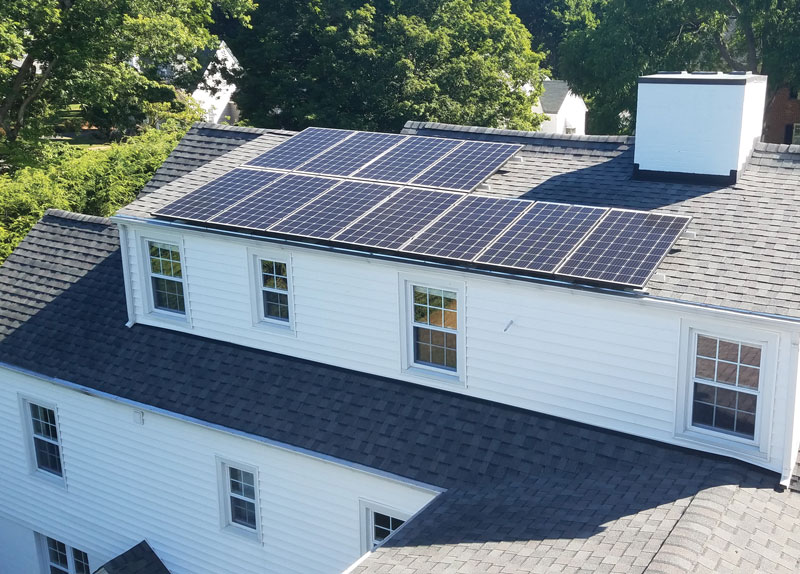
Photo Courtesy of Solar Connexion
Better tech and increased awareness mean there’s never been a better time to power up those panels.
For Russell Bailey, when a team of contractors carried nine solar panels up a tall ladder to a triangular-shaped corner of his roof, it was a dream come true.
He’d been pondering clean power for decades and actively working toward installing a solar system for more than nine years by the time his photovoltaic system was up and operational. To make it happen, he removed a chimney, re-routed his furnace and hot water heater exhausts, immersed himself in reams of research and assured his installer that he was more concerned with generating his own energy than how quickly his panels would pay for themselves.
“I just wanted to offset what we could,” Bailey says, his excitement still palpable two years after putting panels on his South Roanoke home. An app on his phone tracks the energy his system brings in–roughly a quarter of his annual energy use. “Solar is a simple way to offset our energy consumption with an essentially endless, pollution-free energy source.”
Homeowners like Bailey–with an engineering background, a deep commitment to sustainability and a healthy savings account–have typically been the region’s top clean-energy customers. Virginia’s first solar group effort began with a collection of highly educated, committed solar hopefuls in Blacksburg in 2014.
But that may be about to change.
With improved technology making solar less expensive, more efficient and more adaptable, federal incentives slated to shrink starting in 2020, concern that tariffs may cause prices to rise in the future and with more awareness, more support, more installers, there has never been a better time for homeowners to give solar a try.
“Prices have dropped dramatically in the last five years,” says Rick Brown, an electrical engineer who opened his Floyd-based installation company, SolShine Energy Alternatives, in 2010. That means the panels pay for themselves faster, he says. “After that, all the energy you’re producing is free. It also increases the value of your home. It’s a win-win.”
What’s Changed
Ten years ago, a mid-sized solar system installed in Virginia might have cost $25,000, which would take roughly 20 years to pay for itself in energy savings. Panels are guaranteed to last 25 years, meaning a homeowner would potentially have only five years of free energy.
Today, with installations in Virginia 53 percent lower than they were in 2013, according to the Solar Energy Industries Association, a homeowner could pay for the investment in 10 years or less, resulting in at least 15 years of free power.
Additionally, developments in inverter technology mean the energy captured by each panel can be processed separately; if one panel is cast into shade it no longer acts as a drain on the entire system. This improves the performance of panels, even in less-than-optimal conditions.
Another advancement in the solar realm is the amount of information and support available to those interested in alternative energy. Solar United Neighbors is an advocacy group that began in the Washington, D.C. area in 2007, and has now expanded to eight states, including Virginia. Their website offers an easy-to-understand explainer on how solar works, a checklist to see if solar is right for homeowners and a wealth of detailed information on everything from how to choose an installer to how to read an electrical bill.
This year Solar United Neighbors coordinated a solar co-op—“basically an informal buying club,” says Aaron Sutch, program director for Solar United Virginia–for the Roanoke-Botetourt-Blacksburg area. Anyone interested in learning more about solar could attend informational meetings, join the co-op or sign up to receive a reduced price for their system.
“Our job is to make sure people are comfortable with the process of going solar,” says Sutch. Solar United has guided 24 solar co-ops throughout Virginia over the last four years and overseen the installation of 700 systems, he says.
The Greater Roanoke Solar Co-op is no longer accepting members. But a similar group-buying program is scheduled to begin in Floyd this fall, says installer Rick Brown.
Even with all the positives, the initial cost can be a barrier.
“Even though it’s a great investment, it’s still that up-front money that people have a hard time parting with,” explains Brown. “It’s not like a boat or an RV. You don’t get that immediate gratification of ‘Oh boy, I have a new toy.’”
Nell Boyle is the Sustainability and Outreach Coordinator for the city of Roanoke. Being “green” is her job. It’s also a personal priority. And yet, in 2014, when the city of Roanoke last sponsored a solar co-op, Boyle considered but, in the end, did not install any photovoltaics on her home.
“We had some unexpected home repairs come up, and so we passed,” she says, regretfully.
She thinks 2018 will be different.
In 2014, Roanoke’s co-op program added 18 solar systems to city homes, which together increased Roanoke’s capacity for clean energy by 100 kilowatts, Boyle says.
By mid-July this year, 46 people had joined the Greater Roanoke Solar Co-op, without yet committing to installing a solar system. “My hope for the whole program is that maybe we could even triple [the 2014] numbers,” Boyle says.
For her personally, she is serious about going solar on her Botetourt home if she can possibly swing it. “I think it’s important to walk the talk,” she says.
How It Works
Homeowners who will bring in the most energy from their systems have a large, uninterrupted, South-facing expanse. This positions them to collect the sun’s rays the most directly, for the longest amount of time each day.
An inverter, located either on the back of every panel or mounted in a home’s utility room or on an exterior wall, takes the direct current harvested by the panels and converts it into alternating current. In turn, that energy powers a homeowner’s lights, air conditioning, refrigerator and stove.
Appalachian Power, which provides energy to the Western third of Virginia, lists 821 customers in Virginia as having signed on to receive solar credits from their power systems. This number has been steadily rising over the past several years, says spokesman John Shepelwich.
“There’s just this intrinsic value,” Sutch says. “If you grow a tomato from your garden, there’s a sense of pride. You say, ‘I produced this tomato right here.’ You never think about the cost of the water or the seed. A lot of people like the idea of being energy self-sufficient. If you’ve got the technology to generate energy on your property and do it in a cost-effective way, why not?”
Ninety-nine percent of solar systems nationwide are “grid-tied,” meaning homes with solar panels do not store any of the power they collect. They either use it or send it back to the energy company for a credit on their bill. These homes are still connected to their areas’ grids, which provide for their electrical needs whenever their solar system cannot.
Homeowners who have solar panels say they could not be easier to use.
“It’s zero maintenance, basically,” says Chad Braby, a Grandin Court homeowner who installed his system in 2013. “Out of sight, out of mind. … Maybe once a year I’ll go up and hose down the panels, get the pollen off them.”
Braby, like Bailey, has an engineering background and is committed to doing his part to reverse global warming. He had hoped to construct a larger system on his roof but when his installer crunched the numbers, four panels were all it made sense to put in place.
“At the end of the day, it’s a small step,” Braby says. “But I’ve got a tiny little power plant that’s producing clean power; my tiny power plant is putting power back into the grid.”
With inverter technology improving, Braby is considering adding more panels, even though shade will keep them from gathering as much sun as they might. South Roanoke’s Bailey, too, would like to add on.
Solar United’s Sutch says that reaction is common. “I have never had one person in my whole career who has said to me: ‘I regret going solar.’”
“This just keeps growing and growing.” I
… for more from our September/October 2018 issue, Subscribe today, view our FREE interactive digital edition or download our FREE iOS app!