


A new group of Virginia farmers, millers and bakers aims to revive the Mid-Atlantic grain-shed.
Two years ago, fifth-generation farmer Daniel Austin of Franklin County bought five 100-count packets of seed corn. An heirloom variety called John Haulk. He saved all of the ears from his first harvest of the John Haulk to use for seed the next year, except for two, which he milled and cooked into grits at home with his family. Austin still remembers how the first spoonful of the grits tasted — and more specifically, the flavor that wasn’t there.
“A lot of the time — and I’m just a country farmer, so take that for what it’s worth — regular cornmeal, cornbread, grits…taste like cornstarch,” he says. The John Haulk grits were different. “Like buttered sweet corn,” he says. “A deep, rich flavor.” Like “summertime,” his wife Sharon told him after taking a bite.
Austin has farmed grains for seed and animal feed for more than 20 years, and for the last four, has grown and sold food-grade grains, including popcorn, grits, cornmeal, wheat and spelt. He hopes to see locally-grown and produced grains permeate food culture in Virginia, both to celebrate local harvests of varieties like John Haulk and to ensure that future generations of farming families like his own can make a good living. “My goal is economically sustainable farms,” he says. “Being able to pass from one generation to the next, for farming to be part of our culture, part of our communities, part of our livelihood and our life here in Southwest Virginia.”
Austin isn’t alone in his philosophy. Last year, he joined a nonprofit group of farmers, bakers and millers from throughout Virginia and the mid-Atlantic called the Common Grain Alliance (CGA), whose members are working together to build up and boost a regional grain movement.
Launched in October, the Common Grain Alliance aims to make consumers more curious about and hungry for high-quality, local grains, and to ensure that every actor in the “grain chain” — from farming to toasting — can be part of a stronger grain economy. Members around Roanoke include Breadcraft and Deep Roots Milling (Roanoke), eatery Tabula Rasa (Blacksburg), Great Day Gardens (Forest), and Daniel Austin’s grain farm, Taste of Jubilee (Rocky Mount).
Austin calls local grains “one of the last standards of the locavore movement.” That’s because today, most people still buy products made with commodity grain grown in the Midwest. In loaves of bread and bags of corn chips sold in grocery chains, commodity grains still dominate.

CGA member Charlie Wade has navigated these conditions as a sixth-generation local miller based in Roanoke. Wade chooses stone over roller mills for his cornmeal, grits and bread flours, to preserve whole grain nutrients and flavor (roller mills are common to commercial flour, and create a highly-processed product). One of the biggest challenges Wade says he’s faced is competing with the lower prices of commodity flour when selling his product.
“What I offer is going to be at a higher price point,” he says. “There have been a few [bakeries] that have accepted the higher pricing and are willing to work with it, for a better product. But in the end, it comes down to education. You educate the consumer on the differences in the products.”
The Common Grain Alliance aims to do so with efforts like workshops and tabling events that allow producers and consumers to talk and learn about one another’s interests. “One of our near-term goals is to put this idea in people’s minds, just to start asking themselves more about what it is they’re eating,” says farmer and baker Michael Grantz, one of CGA’s founders. “Not just seeing bread as a commodity and something that’s kind of ubiquitous, and everything’s the same, but to start looking at the particulars.”
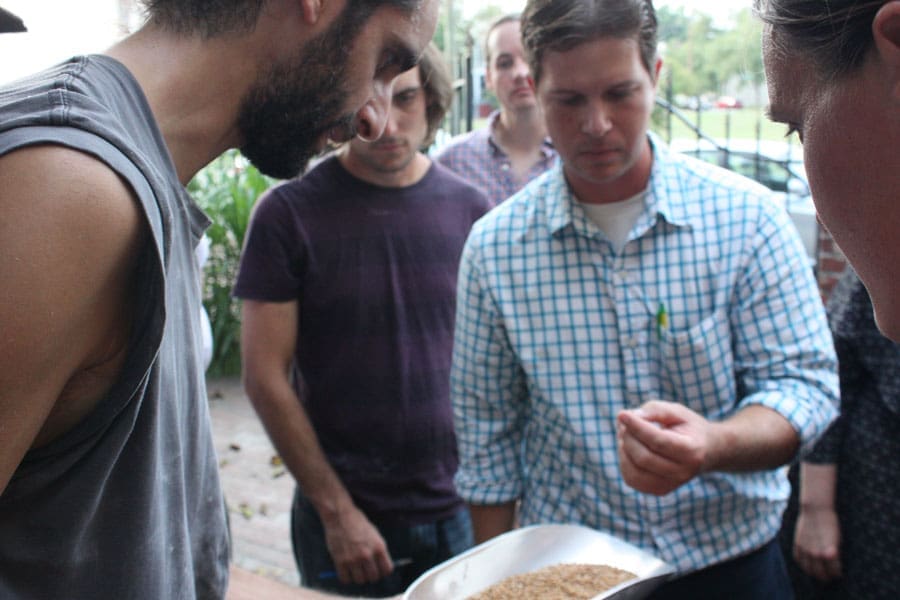
The Common Grain Alliance aims to have consumers asking similar “where” and “how” questions to those that drive the growing public appetite for other local foods, like fruit and meat. “I don’t think that takes a big nudge at all,” says Grantz.
The group’s emphasis on learning extends to its membership of producers as well. CGA holds speaker series, educational field days and regular meetings to enable members to discuss the work they do, their challenges, and what they may need from one another as interconnected members of the grain chain. For farmer Daniel Austin, it’s been useful to get out of his own head and go beyond the “agronomics” perspective that holds his focus.
As a member of CGA, he’s learned about the miller’s focus on flour’s yield — how much can be used versus sifted off during milling — and the baker’s focus on consistency. “Does the batch of flour perform the same year-in and year-out?” he asks. “How well does it rise? How heavy is the bread?” Such questions are new to him. “Those are thoughts that never, ever entered into my equation.”
The Common Grain Alliance welcomes anyone with an interest in local grains to join, and plans to host panel discussions this month at several state and regional conferences focused on small farms. To Grantz, the group is coming together during a hopeful moment of transition for local grains. “I think there’s definitely more demand,” he says.
Grantz has sold bread from Great Day Gardens, a market garden and wood-fired bakery he runs with his wife, Arden Jones, at farmers markets (such as the Grandin Village market in Roanoke) for the past five years. “There have been more people asking me about what kind of flour I use, where the wheat is grown,” says Grantz. “I think there’s progress, but there’s still a lot of room to grow.”


